
Every team that tests with realistic data eventually faces the same question: how do we make this data safe without making it useless? There are four common answers: static data masking, tokenization, synthetic data and subsetting. Vendors tend to argue for whichever one they sell. In practice, most organisations need a combination, and the right choice depends on the environment, the data and what the tests actually need.
This guide gives you a practical way to decide. It covers what each method protects, how they compare on test realism, effort and compliance, a decision flowchart, and how to match methods to each environment.
The Four Methods at a Glance
- Static data masking replaces sensitive values in a copy of production data with realistic substitutes and keeps no mapping back to the original. The structure, formats and relationships stay intact, so tests behave as they would in production.
- Tokenization replaces sensitive values with tokens. In its reversible form, an authorized system can retrieve the original through a vault or a cryptographic key. It is built for production workflows that need the original back, such as payment processing.
- Synthetic data is generated from rules, models or schemas rather than copied from production. Because no real records are involved, nothing real can leak, but realism depends on how well the generator models your data.
- Subsetting extracts a smaller, referentially intact slice of production data. It reduces the volume of sensitive data in test, along with storage and refresh time, but it does not protect the records it keeps. Subsetting is a companion to masking, not a substitute for it.
Encryption at rest is often mentioned alongside these, but it is not a test data protection method on its own. Testers and applications see decrypted values when they use the data, so it protects the disk, not the people looking at the records.
Comparison Matrix
| Criteria | Static masking | Tokenization (reversible) | Synthetic data | Subsetting |
|---|---|---|---|---|
| What it protects | Sensitive values in the copy | Sensitive values in connected systems | Everything; no real records | Nothing by itself; reduces how much data is exposed |
| Reversible? | No | Yes, for authorized systems | Not applicable | Not applicable |
| Test realism | High; real patterns, volumes and edge cases preserved | High for structure; tokens are not realistic-looking values unless format-preserving | Varies; depends on the generator | High for the records kept |
| Referential integrity across systems | Yes, if masking is consistent across systems | Yes, if tokens are deterministic | Hard across many systems; depends on the tool | Yes, if relationships are followed during extraction |
| Set-up effort | Medium: discovery, rules, validation | High: vault or key infrastructure | Medium to high: modelling rules and relationships | Medium: defining the slice |
| Ongoing effort | Re-run on every refresh | Operate and secure the token service | Maintain generators as schemas change | Re-run on every refresh |
| Compliance fit | Strong for non-production, if the whole dataset is de-identified | Strong in production; adds in-scope infrastructure to test | Strongest; no personal data | Helps by data minimisation; data kept is still regulated |
| Best for | SIT, QA, UAT and performance testing | Testing systems that must detokenize | New features, demos, training, external partners | Large estates where full copies are slow or costly |
Five Questions That Decide It
Work through these questions for each data set or environment. The flowchart below shows the same logic.
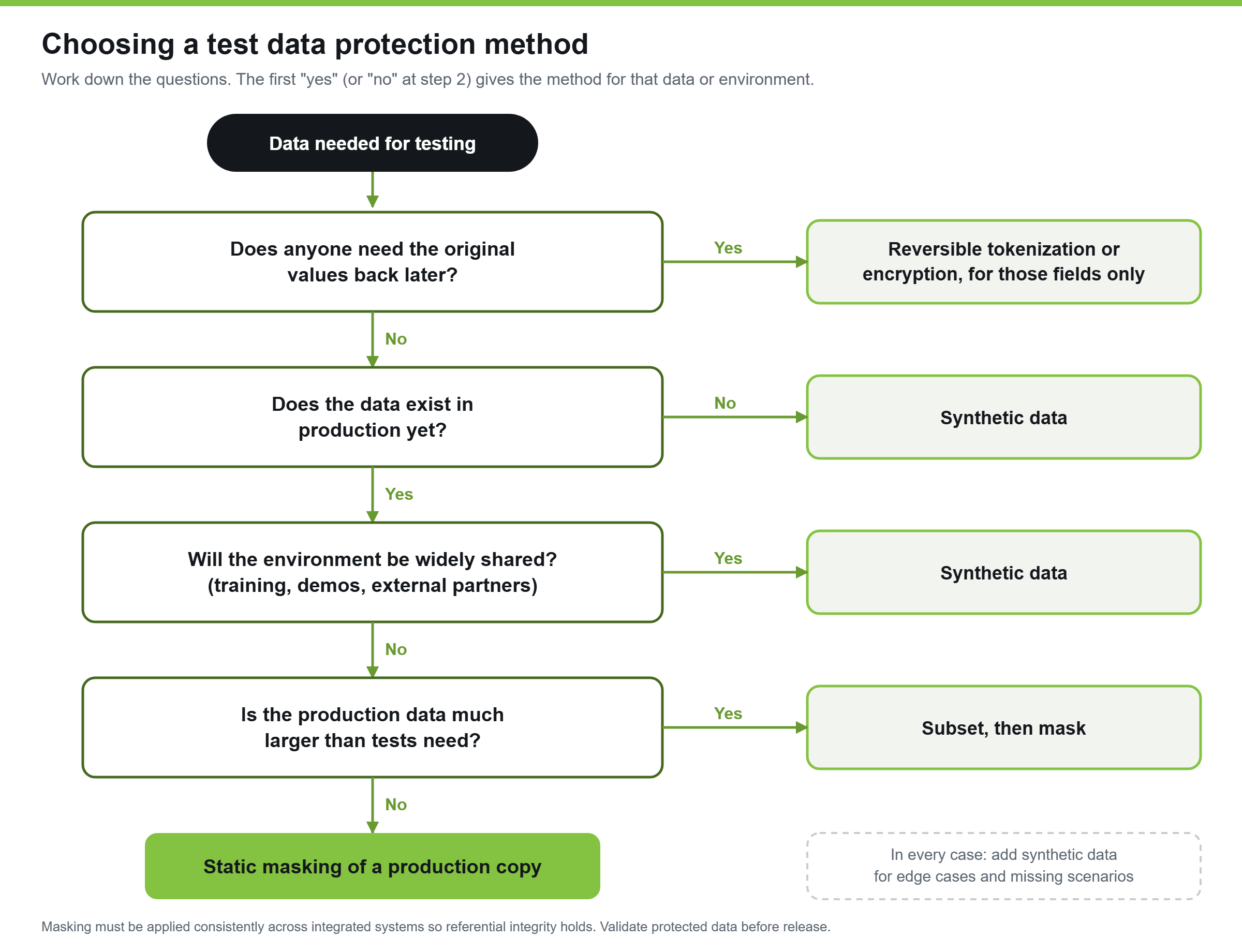
- Does anyone need the original values back later? If yes, use reversible tokenization or encryption, but only for the specific fields that need it. Everything else can still be masked.
- Does the data exist in production yet? If you are testing a new feature, product or data model, there may be nothing to copy. Generate synthetic data.
- Will the environment be widely shared? Training, demo and partner environments reach large or external audiences. Synthetic data removes the risk entirely and is usually realistic enough for these purposes.
- Is the production data much larger than the tests need? Subset first to a representative, referentially intact slice, then mask it. You protect less data, refresh faster and store less.
- Otherwise: use static masking of a production copy. It gives the highest realism for integration, regression and user acceptance testing.
Whatever you choose, add synthetic records to cover edge cases and scenarios that production data does not contain.
Matching Methods to Environments
| Environment | Recommended approach | Why |
|---|---|---|
| Development | Synthetic data, or a small masked subset | Developers rarely need volume, and access is often broad |
| System and integration test | Masked production copy, consistent across systems | Interfaces and joins must line up across applications |
| QA and regression | Masked subset plus synthetic edge cases | Repeatable data sets with good coverage |
| UAT | Masked production copy | Business users need recognisable, realistic scenarios |
| Performance and load | Masked full-volume copy, or synthetic data at scale | Volume and distribution matter more than individual records |
| Training and demo | Synthetic data | Wide audiences and long-lived environments |
| Systems that must detokenize | Tokenization with test-only keys or vault | The application logic depends on retrieving originals |
For more on where each environment leaks data, see our guide to preventing data leakage in test environments.
Masking vs Tokenization for Test Data
The key difference is reversibility. Static masking keeps no route back to the original, which is exactly what most test environments need. Reversible tokenization keeps that route, which means running and securing a vault or key service, and that service then sits inside your compliance scope. Unless an application under test genuinely needs to detokenize, masking is usually the simpler and safer choice. Enov8 has a detailed comparison of masking and tokenization, and if you do need tokenization, DataOpsZone explains how vaulted and vaultless architectures differ.
Masking vs Synthetic Data
Masked data keeps the real-world patterns, volumes and quirks of production, including the odd records that find real defects. Synthetic data carries no privacy risk and can create scenarios production never had, but it only reflects what the generator knows about your data, and keeping relationships consistent across many systems is hard. Most mature teams use masked data for integration and acceptance testing and synthetic data for development, demos and edge cases. For a deeper look, see synthetic data vs masked real data for software testing.
Common Mistakes
- Masking each system differently. If a customer ID is masked one way in the CRM and another way in billing, integration tests break. Use consistent, deterministic rules across systems.
- Treating subsetting as protection. A smaller copy of real data is still real data.
- Calling encryption masking. Encrypted data that testers can decrypt has not been de-identified.
- Tokenizing test data by default. It adds infrastructure and compliance scope that most test environments do not need.
- Assuming synthetic data is realistic enough. Validate that it exercises the same paths and edge cases as production.
- Protecting once and forgetting. Every refresh brings real data back unless protection runs as part of it.
- Skipping validation. Check that no real values remain before data reaches test teams.
Conclusion
There is no single best test data protection method. Start with one question: does anyone need the original values back? For most test environments the answer is no, which makes static masking the default for realistic testing, subsetting the way to keep volumes manageable, and synthetic data the answer for new features and widely shared environments. Keep tokenization for the systems that genuinely need to reverse it.
Platforms such as Enov8 Test Data Manager and Data Factory bring these methods together, with profiling to find sensitive data, consistent masking across systems, subsetting and synthetic data generation. Learn more about Enov8 test data management, or compare options in our test data management tools comparison.
TestEnvironmentManagement.com is an Enov8 resource. Links to Enov8 pages are included where they add detail or show how a product addresses the problem described.